
Calorie Counter
Calorie Counter from NE1.net is an iOS app that makes it possible to count calories in the food that you consume.
What it does
- In addition you can get the app to calculate a daily calories limit for your wanted weightloss.
- With this you can track your daily performance against your daily calories limit, which should ensure at weightloss according to your goal.
Screenshots
-
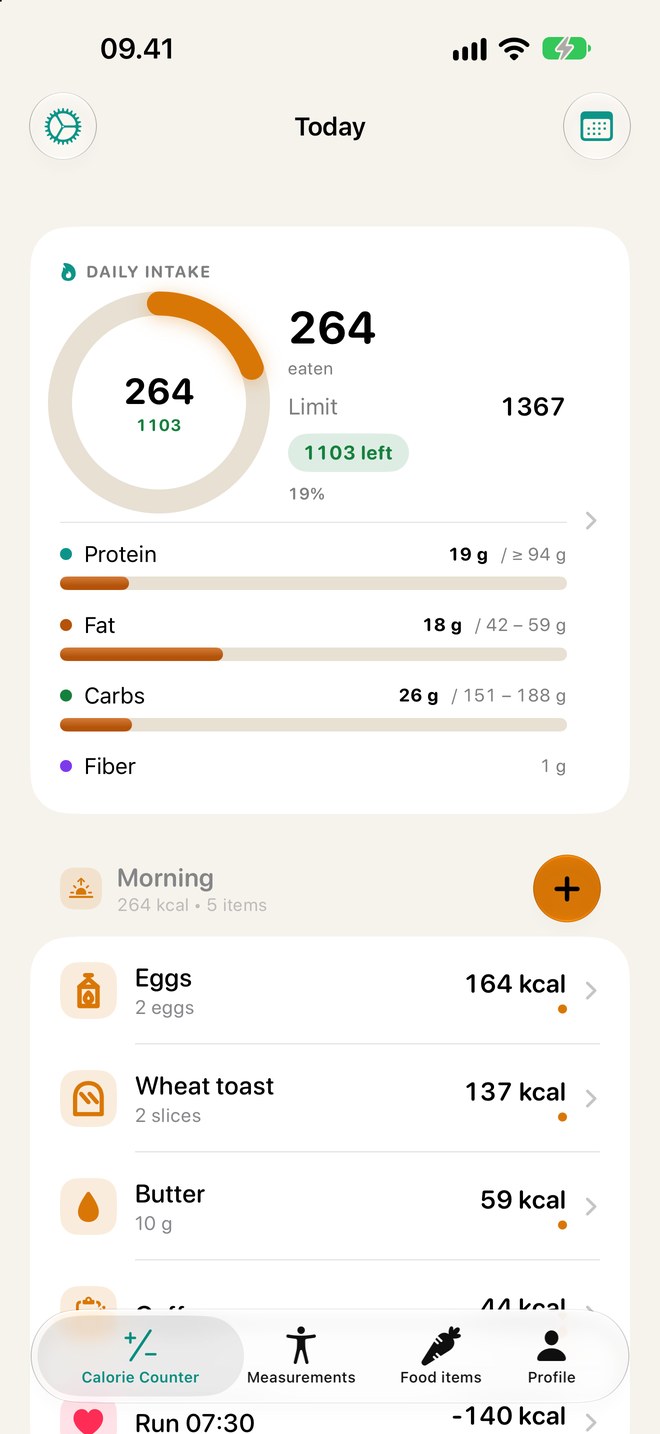
Track calories & macros
-
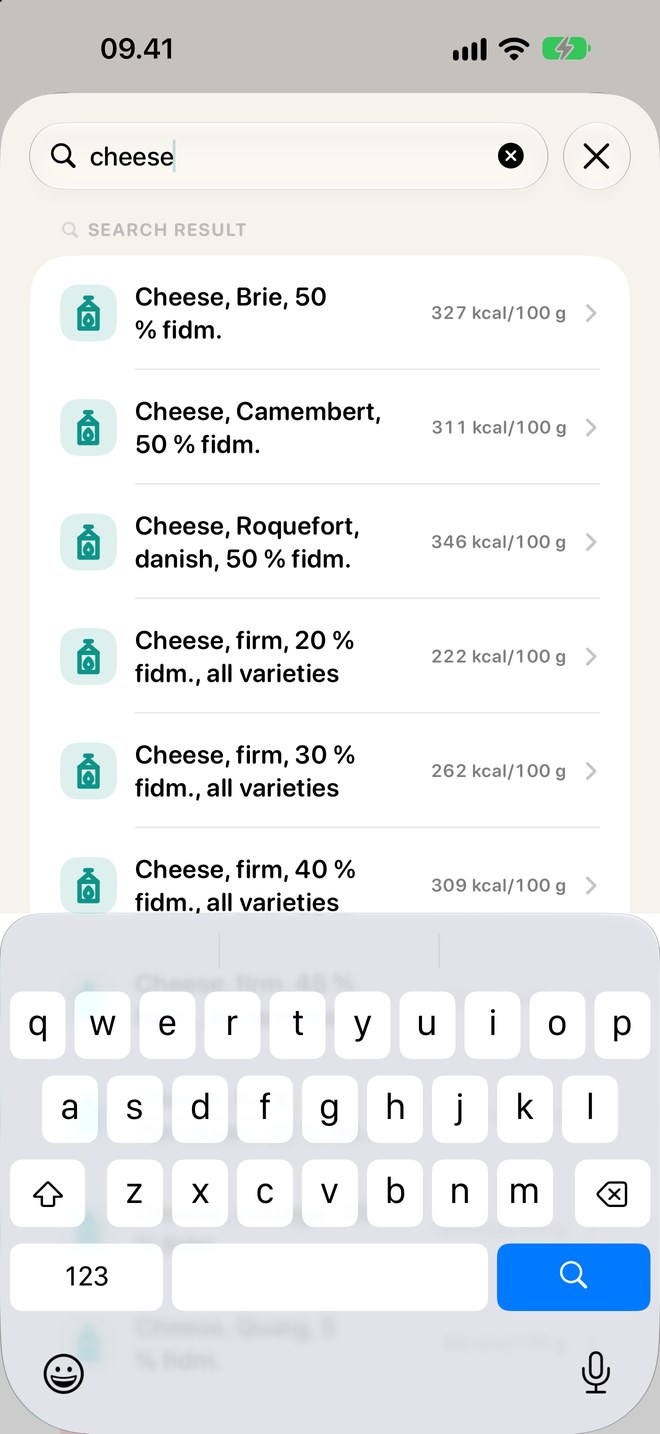
Huge food database
-
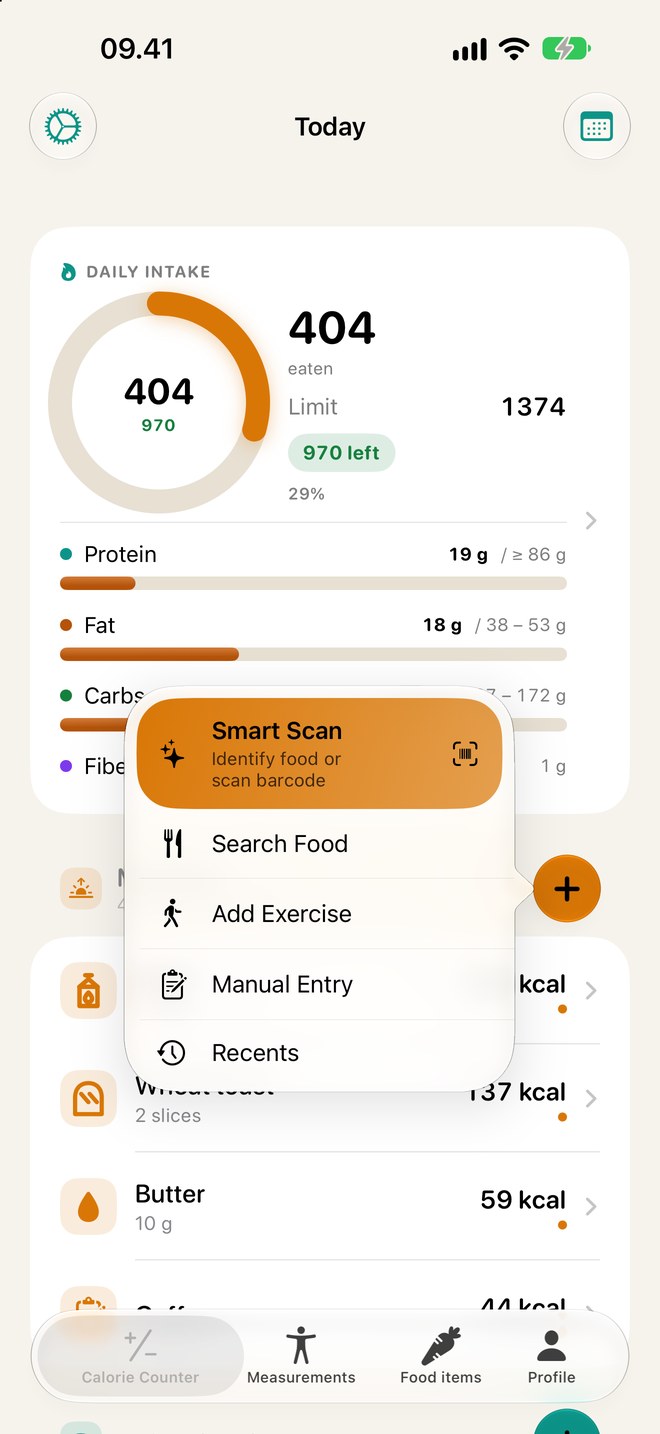
Log with a photo
-
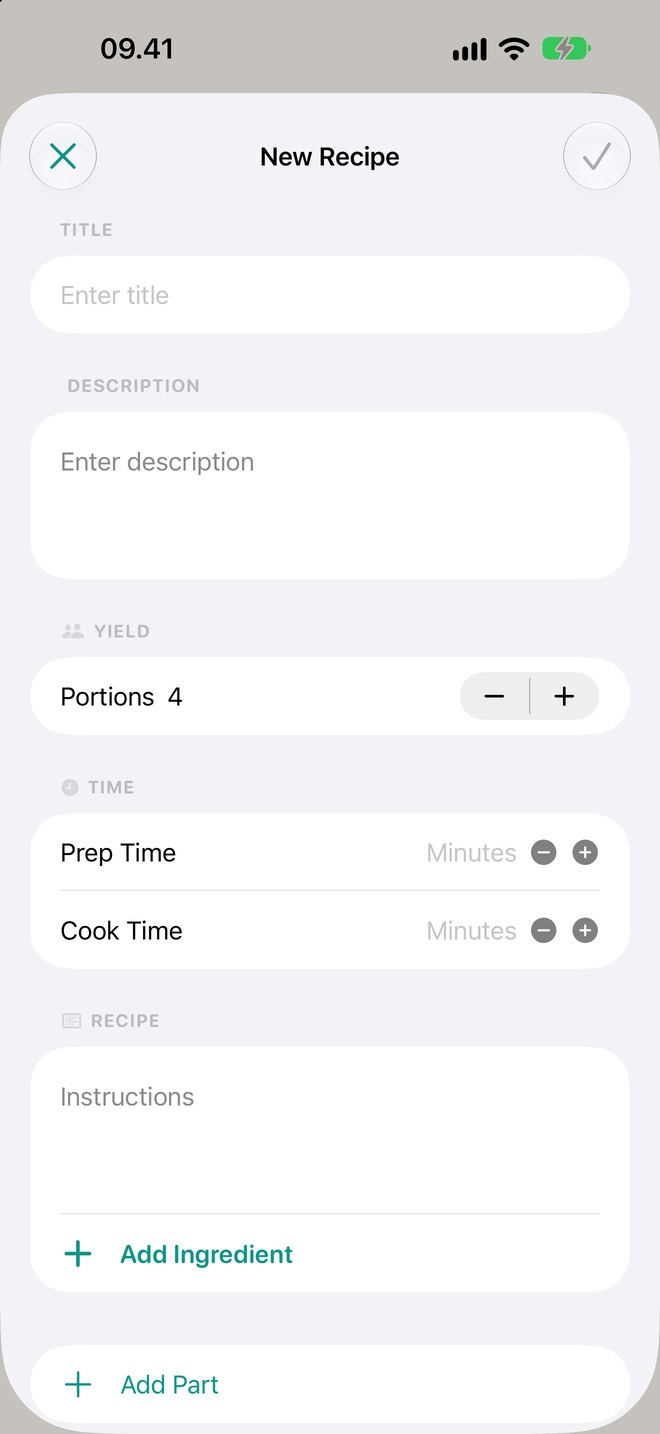
Create & save your recipes
-
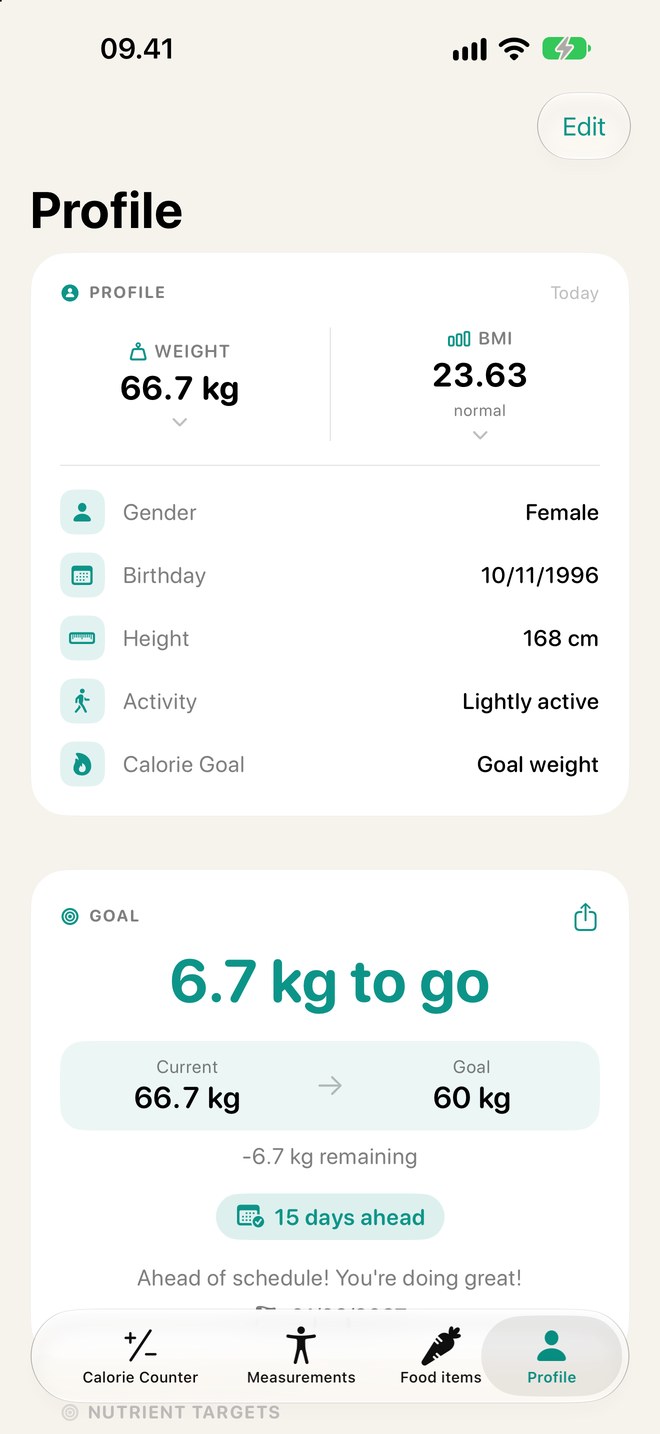
Set goals, follow progress
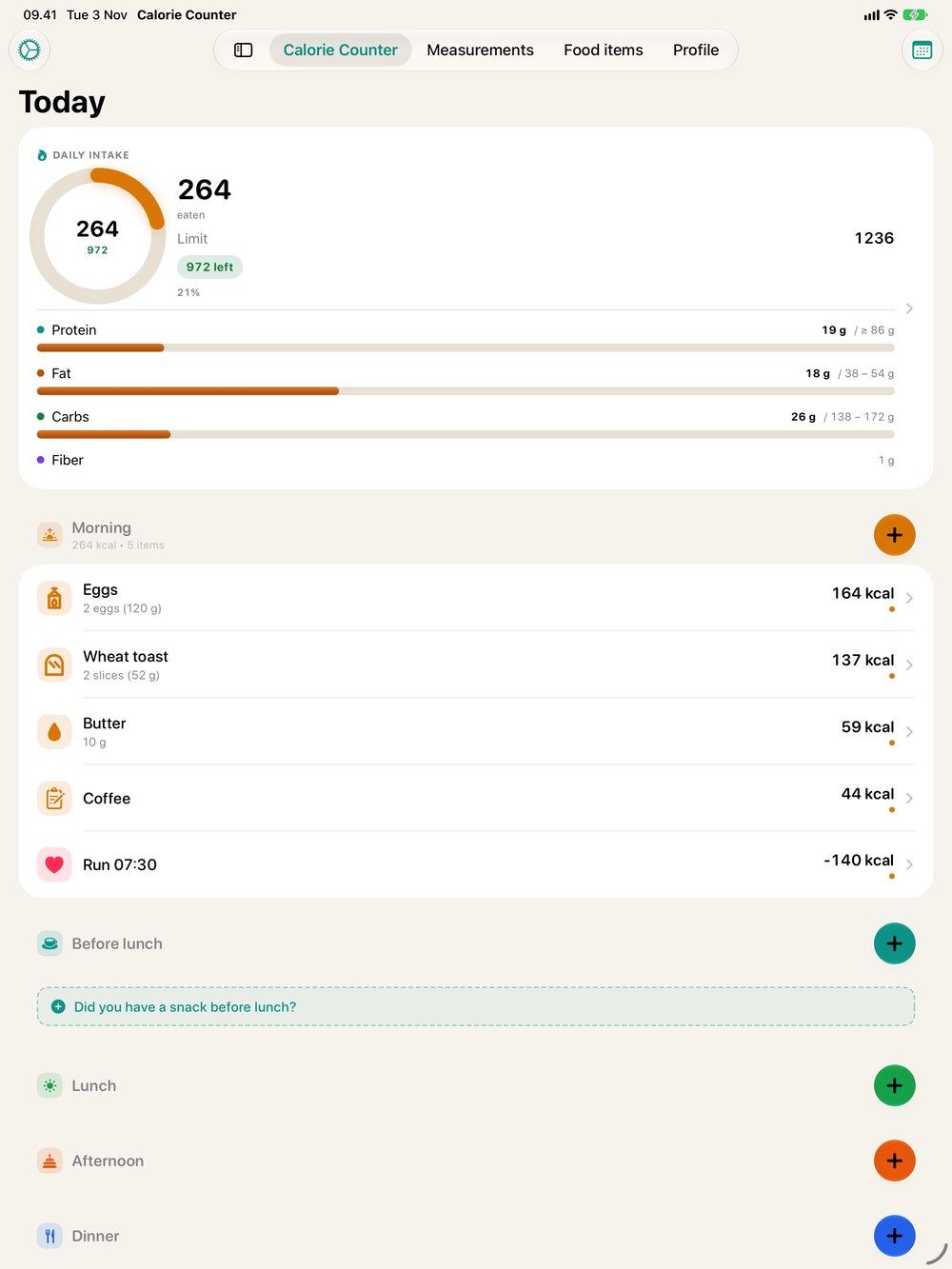
The same app, laid out for the bigger screen.
How the numbers work
The app estimates energy rather than measuring it. Every number it shows comes from your profile, your entries and the methods described here. The daily calorie limit is the one that drives the rest.
The daily calorie limit
Your limit is built in four steps, each a standard method applied to the details in your profile and your latest weight.
- Resting energy. From your gender, age, height and weight the app estimates how much energy your body uses at complete rest: your basal metabolic rate. It uses the Mifflin-St Jeor equation, one of the usual ways to estimate this.
- Total daily burn. That resting rate is multiplied by an activity factor for how much you move in a normal week, from 1.2 for a sedentary day up to 1.9 for a physically demanding one. The result is your total daily energy expenditure (TDEE): roughly what you burn in a day at your current activity level.
- The deficit. Your goal weight and the date you want to reach it decide how much is subtracted. The app aims for the pace you asked for, assuming about 7,700 kcal per kilogram of body weight: roughly 500 kcal a day for half a kilo a week. If you have not set a goal weight and a date, nothing is subtracted and the limit is your total daily burn.
- The floor. A calculated limit is never set below 1,200 kcal for women or 1,500 kcal for men. If your goal would need less, the app raises the limit to the floor and tells you why. A limit you set yourself in your profile is used as it is, even below the floor; there the app only warns you.
Calories you log as exercise count against the day's intake, so a long run leaves more room under the limit, and your macronutrient targets rise with it. Workouts imported from Apple Health use the energy your watch measured rather than the app's own estimate.
Basal metabolic rate Physical activity level Total daily energy expenditure Weight loss
Exercise
An exercise entry is estimated from how long you did it, how hard it was and your weight. The intensity comes from the metabolic equivalent of task (MET), a number for how many times harder the activity is than sitting still, so the same half hour of running burns more than the same half hour of walking. The app uses the weight you had on that day, and assumes 85 kg if you have never logged one.
Body measurements
From your weight, height, waist, hips and body-fat percentage the app derives the usual body measurements: BMI, the waist-to-hip and waist-to-height ratios, lean body mass and fat mass, and mean arterial pressure from a blood-pressure reading. Each follows its standard definition.
Body mass index Waist-to-hip ratio Waist-to-height ratio Lean body mass Body fat percentage Mean arterial pressure
Macronutrients
Protein, fat and carbohydrate targets are given as a share of your calorie limit; the four presets (Balanced, Low carb, High protein and Keto) only change those shares. The app turns a share into grams with the standard energy values of 4 kcal per gram of protein and carbohydrate and 9 kcal per gram of fat. Dietary fibre is a fixed number of grams instead.
What feeds the numbers
The estimates are only as good as the details behind them: gender, age, height, activity level, goal weight and goal date, plus your latest weight entry. Without them the app cannot estimate a limit (a limit you fix yourself still applies), and it warns you when the latest weight is more than 30 days old. Edit your profile or log a new weight and the numbers change with it.
These are estimates for a generally healthy adult, not medical advice. They say nothing about what is right for you in particular. If you are pregnant, ill, or following a diet for a medical condition, talk to a doctor or dietitian before you use a calorie limit.
Food database
Our foods database contains foods from the Danish the National Food Institute (Fødevareinstituttet), the Norwegian Matvaretabellen, the Swedish Livsmedelsverket as well as thousands of foods shared by our users over the years.
We cannot guarantee the accuracy of the foods database, if you see anything that looks out of order please contact us.
Sources
- Fødevareinstituttet · DK
- Matvaretabellen · NO
- Livsmedelsverket · SE
Privacy
The Calorie Counter app uses Google Analytics to measure aggregated feature usage. No diary content is sent to Google.
The free version of the Calorie Counter app shows ads from Google AdMob. Subscribing removes ads and AdMob does not run for subscribers.
Feedback
Feedback is always welcome on the following email: